

FUNCTIONAL LIMITATION CAN DISTINGUISH AN INVENTION WHERE PRIOR ART DOES NOT TEACH THE CLAIMED FUNCTION
 CASE: ITC LIMITED V. PHILIP MORRIS PRODUCTS S.A. & ORS. (10 SEPTEMBER 2026)
SECTIONS 2(1)(JA), 25(2)(B), 25(2)(E), 25(4) & 117A, PATENTS ACT, 1970
The matter concerned a post-grant opposition to Indian Patent No. 384250 titled “Heated Aerosol Generating Article with Thermal Spreading Wrap”. The patent claims a heated aerosol-generating article having an aerosol-forming substrate surrounded by a thermally conductive sheet that acts as a flame barrier, spreading heat and reducing the risk of ignition when an external flame is applied. ITC challenged the patent on, inter alia, novelty and inventive step.
Submissions of the Appellant
The Appellant contended that D1 disclosed substantially all features of Claim 1, including an aerosol-forming substrate surrounded by metallic foil. It argued that the claimed flame-barrier function was merely an inherent property of thermally conductive metal foil and therefore could not impart novelty or inventive step.
The Appellant further relied on D2-D10, arguing that the use of metal/aluminium foil for conducting and spreading heat was known and that a skilled person would have been motivated to use such foil to reduce the risk of ignition. It was also argued that D2-D6 could be combined with D1 to establish obviousness.
Submissions of the Respondents
The Patentee argued that the claimed wrapper was not merely a known metal foil but was specifically configured to function as a thermally conducting flame barrier. D1 used its wrapper as a heat-transfer medium to transfer heat from the heating element to the tobacco, whereas the claimed wrapper dissipated heat from an externally applied flame to prevent ignition.
It was further submitted that D2-D6 related principally to conventional smoking articles involving combustion and therefore did not provide a motivation to modify D1, which concerned electrically heated aerosol-generating articles.
Court’s Analysis
The Court held that D1 did not disclose all the features of Claim 1. In particular, D1 did not disclose the claimed thermally conductive wrapper functioning as a flame barrier to spread heat and mitigate ignition when an external flame was applied. The Court noted that the wrapper in D1 functioned as a heat sink/heat-transfer medium, transferring heat from the heating element to the tobacco, whereas the claimed wrapper functioned as a heat dissipator/flame barrier.
The Court also held that a functional limitation associated with a structural element can limit the scope of a claim where the structure is required to be capable of performing that function. Therefore, the Appellant could not simply treat the flame-barrier function as an irrelevant inherent property of metal foil.
For inventive step, the Court reiterated the five-step approach: identify the skilled person, identify the inventive concept, determine common general knowledge, identify the differences from the prior art, and determine whether those differences would have been obvious without hindsight.
The Court found that D2-D6 were not analogous to D1 because they principally concerned conventional smoking articles using combustible heat sources, whereas the claimed invention concerned an electrically heated aerosol-generating article. There was therefore no sufficient teaching, suggestion or motivation for the skilled person to combine those references with D1 to arrive at the claimed invention.
The Court consequently held that D1, alone or in combination with D2-D10, did not render the claimed invention obvious. It also rejected the argument that the claimed flame-barrier function was merely an inherent property of the prior-art wrapper, noting that no material had been placed on record to establish this proposition.
Conclusion
The Court dismissed ITC’s appeal and writ petition and upheld the Controller’s rejection of the post-grant opposition. The Court found that the prior art neither disclosed nor suggested the claimed thermally conductive flame-barrier function, and that the proposed combination of references lacked the necessary analogous relationship and motivation to combine.
PATENT REFUSAL MUST BE REASONED: MERE CONCLUSIONS CANNOT REPLACE PRIOR-ART ANALYSIS
 CASE: CASSIOPEA S.P.A. V. CONTROLLER GENERAL OF PATENTS AND DESIGNS & ORS. (31 AUGUST 2026)
SECTIONS 2(1)(J), 2(1)(JA), 3(E), 10, 15, 25(1) & 117A, PATENTS ACT, 1970
The matter concerned an appeal against refusal of a patent application titled “High Concentration Formulation”, relating to a topical pharmaceutical formulation comprising cortexolone-17-α-propionate. The Controller rejected the application on grounds including lack of novelty, inventive step and non-patentability under Section 3(e). The Applicant challenged the order as being non-speaking, procedurally defective and unsupported by proper analysis of the cited prior art.
Submissions of the Appellant
The Appellant contended that the Controller’s order was unreasoned and non-speaking, as it largely reproduced the objections and the parties’ submissions without explaining why the Applicant’s arguments were rejected.
It was further submitted that the Controller failed to compare the disclosures of the cited prior arts with the claimed invention and merely stated that the claimed active ingredient, solvents and additives were known. The Appellant also challenged the refusal to consider the proposed claim amendments and the denial of an opportunity to submit counter-evidence after amendment of the claims.
Submissions of the Respondents
The Respondents defended the Controller’s order as a reasoned decision, submitting that the Applicant had failed to establish novelty, inventive step and patentability.
Court’s Analysis
The Court held that the impugned order was non-speaking and cryptic. It emphasised that reasons are the “heart and soul” of an order because they allow the applicant to understand the basis of the decision and enable an appellate court to review it.
The Court found that the Controller had not discussed the teachings and disclosures of the cited prior arts or compared them with the features of the claimed invention. Merely stating that the ingredients and solvents were known could not establish lack of novelty or inventive step without analysing what each prior art actually disclosed and how it related to the claims.
The Court also found that the Controller gave contradictory findings regarding the Applicant’s proposed amendments and opportunity to lead counter-evidence. The Applicant had amended the claims to overcome the objections, but the amendments were refused without adequate reasoning. This was held to violate the Applicant’s right to be heard.
With respect to Section 3(e), the Court noted that the Controller had not even explained how the provision applied to the claimed formulation or determined whether the claimed composition constituted a mere admixture.
Accordingly, the Court held that the Controller had failed to undertake the legally required analysis of novelty, inventive step and non-patentability and had also failed to provide adequate reasons for rejecting the claim amendments.
Conclusion
The Court set aside the impugned order and remanded the matter to the Controller for fresh consideration, directing that the Applicant and the Respondent/opposer be given an opportunity of hearing. The matter was directed to be decided within four months. The Court expressly clarified that it had not expressed any opinion on the merits of the patentability of the invention.
IDENTICAL MARKS, COUNTERFEIT GOODS: DELHI HIGH COURT GRANTS IMMEDIATE PROTECTION AGAINST INFRINGING SKF BEARINGS
 CASE: AB SKF V. M/S B.M. BEARING SALES & ORS. (21 AUGUST 2026)
SECTIONS 28 & 29, TRADE MARKS ACT, 1999
The matter concerned a suit filed by AB SKF against the Defendants for selling counterfeit ball bearings bearing the Plaintiff’s registered “SKF” marks and identical packaging/trade dress. The Plaintiff alleged trademark infringement, passing off and copyright infringement and sought an ex parte interim injunction.
Submissions of the Plaintiff
The Plaintiff submitted that it was the registered proprietor of the SKF marks and had extensive goodwill and reputation in the bearing industry. It alleged that the Defendants were selling counterfeit bearings using identical SKF marks and packaging, through common trade channels, creating a likelihood of confusion among consumers.
The Plaintiff further submitted that the counterfeit bearings were of inferior quality and could create a safety risk, while the copied packaging and artistic elements also infringed its copyright. The Plaintiff relied on investigation material, invoices and online listings to establish the Defendants’ sale of the counterfeit products.
Court’s Analysis
The Court found that the Plaintiff had established a prima facie case for an ex parte injunction. It noted that the Defendants were prima facie selling counterfeit bearings bearing marks identical to the Plaintiff’s SKF marks, while the competing products had the same consumer base and trade channels, giving rise to a likelihood of confusion.
The Court also compared the rival packaging and found that the Defendants had copied the Plaintiff’s packaging substantially as a mirror image, thereby prima facie infringing the copyright in the artistic work forming part of the trade dress. The use of identical marks and trade dress on identical goods was also found to prima facie constitute trademark infringement and passing off.
The Court gave particular importance to the fact that the goods were ball bearings used in vehicles and machinery. Since the allegedly counterfeit products were stated to be inferior in quality, their sale could cause damage to the Plaintiff’s reputation and could also pose a safety risk to the public.
The Court also considered the evidence indicating that the Defendants had received substantial proceeds from the sale of the infringing goods and found an apprehension that the money could be withdrawn or transferred if not secured.
Conclusion
The Court granted an ex parte ad interim injunction, restraining the Defendants and others acting on their behalf from using the SKF marks, including as trademarks, domain names, email IDs or social-media handles, and from using identical or deceptively similar trade dress/packaging in relation to ball bearings. The Court also directed the concerned bank to mark a lien on the identified bank accounts to secure the amounts allegedly received from the infringing activities.
PHONETIC SIMILARITY MATTERS: LONG-STANDING PRIOR USE CAN WARRANT INJUNCTION
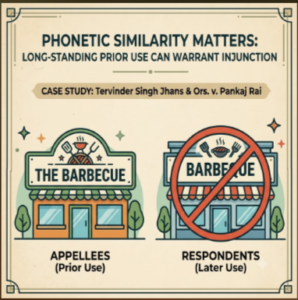 CASE: TERVINDER SINGH JHANS & ORS. V. PANKAJ RAI & ORS. (1 SEPTEMBER 2026)
SECTION 29, TRADE MARKS ACT, 1999; AND SECTIONS 2(C) & 13, COPYRIGHT ACT, 1957
The matter concerned an appeal against refusal of an interim injunction in a trademark and copyright suit. The Appellants had operated a restaurant under the name “BARBECUE/BARBEQUE” in Nagpur for over 30 years and held rights in the associated device mark and artistic work. The Respondents subsequently operated an online food business under the name “Barbecue Gokulpeth” through platforms such as Zomato and Swiggy.
Submissions of the Appellants
The Appellants contended that the Respondents’ use of “Barbecue/Barbeque”, together with similar branding and representation, was deceptively and phonetically similar to their mark and artistic work. They argued that the use of the similar name for identical/similar food services was likely to cause consumer confusion, particularly on online food-delivery platforms.
They further relied on their long-standing use, goodwill, registered device mark and copyright registration and submitted that continued use by the Respondents would cause irreparable injury to their goodwill and reputation.
Submissions of the Respondents
The Respondents argued that “BARBECUE” and “BARBEQUE” were different expressions and that the Appellants did not possess an exclusive right over the individual word. They contended that their business was a cloud kitchen operating from Gokulpeth and was distinguishable from the Appellants’ restaurant at Sadar.
It was also submitted that the Appellants’ registration was for a composite/device mark, comprising the word together with a distinctive logo and colour scheme, and not an exclusive registration of the standalone word.
Court’s Analysis
The Court held that “Barbecue” and “Barbeque” are phonetically similar and that the Respondents were using the similar expression for food-related services. The Court also considered the Appellants’ long-standing use, registered device mark and copyright in the artistic work.
Relying on the principles in Renaissance Hotel, Heinz Italia, Parle Products and other precedents, the Court emphasised that deceptive similarity is assessed by considering the overall commercial impression, including visual and phonetic similarity, rather than focusing on minor differences between the marks.
The Court rejected the Trial Court’s reasoning that the parties operated from different geographical locations. It observed that the Respondents were supplying food through Zomato and Swiggy, and the use of the phonetically similar name in the same field could create confusion and affect the Appellants’ goodwill.
The Court accordingly found that the Appellants had established the three requirements for interim injunction prima facie case, balance of convenience and irreparable injury.
Conclusion
The Court allowed the appeal, set aside the Trial Court’s order refusing interim relief, and restrained the Respondents, during the pendency of the suit, from using, selling, advertising, circulating or otherwise dealing with “BARBECUE/BARBEQUE” or any deceptively similar mark, label, device or artistic work of the Appellants.
OWNING THE PHOTOGRAPH IS NOT OWNING THE COPYRIGHT: PHYSICAL POSSESSION CANNOT DEFEAT COPYRIGHT
 CASE: THE CINEMA RESOURCE CENTRE V. GANGA RUDRAIAH & ORS. (27 AUGUST 2026)
SECTION 17, COPYRIGHT ACT, 1957
The matter concerned copyright in production photographs taken during the making of the Tamil film Aval Appadithan. The photographs were in the possession of The Cinema Resource Centre, which had acquired them from a scrap dealer, restored and digitised them, and displayed them in its archive. The legal heirs of the film’s producer-director claimed copyright in the photographs and sought their return and an injunction against their further use.
Submissions of the Appellants
The Appellants contended that merely being the producer and director of the film did not make late Mr. Rudraiah the copyright owner of every photograph taken during production. They argued that there was no documentary evidence establishing who engaged the photographers, whether they were paid valuable consideration, or whether copyright had been assigned to Rudraiah.
They further contended that they had lawfully purchased the physical photographs and had spent considerable time and money restoring, digitising and preserving them.
Submissions of the Respondents
The Respondents submitted that the photographs were production photographs taken during the making of the film, by photographers engaged for the film production. Since Rudraiah was admittedly the producer and director, the photographs were taken at his instance and for the purposes of the production.
They further argued that the Appellants had no assignment or licence from the copyright owner and that possession or purchase of the physical photographs could not confer copyright.
Court’s Analysis
The Court held that ownership of the physical photographs and ownership of copyright are distinct rights. The Appellants’ purchase and preservation of the photographs did not give them copyright, particularly when they could not establish any assignment or licence in their favour.
Applying Section 17 of the Copyright Act, the Court observed that although the photographer is ordinarily the first owner, where a photograph is taken for valuable consideration at the instance of another person, that person is the first owner, unless there is an agreement to the contrary.
The Court considered the surrounding circumstances, including that Rudraiah was admittedly the producer and director, the photographs were production photographs connected with the film, and no photographer or other person had asserted competing copyright. On the overall evidence and probabilities, the Court upheld the finding that copyright vested in Rudraiah.
The Court also rejected the defence of acquiescence. Mere knowledge that the photographs were in the Appellants’ possession, or appreciation of their preservation and digitisation work, did not amount to an assignment, licence or relinquishment of copyright. Such transfer or relinquishment requires the legally prescribed basis.
Conclusion
The Court dismissed the appeal and confirmed the decree declaring the Respondents’ copyright in the production photographs, directing return of the originals and restraining further publication or communication of the photographs.
ROGUE WEBSITES CANNOT PROFIT FROM PIRATED CONTENT: PERMANENT INJUNCTION GRANTED
 CASE: STAR INDIA PVT. LTD. V. VEGAMOVIES.PET & ORS. (8 SEPTEMBER 2026)
SECTIONS 14(D), 37 & 51, COPYRIGHT ACT, 1957
The matter concerned a copyright infringement suit filed by Star India against numerous websites allegedly engaged in unauthorised hosting, streaming and communication of Star India’s copyrighted content, including programmes such as Shaitani Rasmei, Big Boss, Showtime and Aarya. The Court had earlier granted an ex parte interim injunction and directed domain-name registrars, DoT and MeitY to take blocking and suspension measures. During the proceedings, the number of impleaded defendants increased to 1094.
Submissions of the Plaintiff
The Plaintiff submitted that it owned copyright and broadcasting rights in the relevant content broadcast on its Star Channels and Disney+ Hotstar. It contended that the Defendant websites were communicating, hosting and streaming the copyrighted works without authorisation, thereby infringing its exclusive rights under the Copyright Act.
The Plaintiff further submitted that the unauthorised websites diverted viewers from legitimate channels and provided the content free of cost, resulting in loss of revenue and contributing to online piracy.
Submissions of the Respondents
The Defendants did not contest the proceedings. Their rights to file written statements had been closed after expiry of the statutory and condonable periods, and they were proceeded against ex parte. The relevant domain-name registrars, DoT and MeitY had complied with the directions issued by the Court.
Court’s Analysis
The Court held that, in the absence of written statements, the averments in the plaint and the supporting documents stood admitted in accordance with the applicable Delhi High Court Rules. On the basis of the pleadings and documents, the Court found that Star India had established its copyright and broadcasting rights in the works in question.
The Court found that Defendants 1 to 1093 were rogue websites that were streaming, hosting and broadcasting Star India’s copyrighted works without authorisation. Such unauthorised exploitation constituted infringement under Section 51 of the Copyright Act. The Court also noted that the piracy diverted viewership from legitimate channels and caused revenue loss to the Plaintiff.
Since the Defendants had failed to contest the suit and the infringement had been established from the record, the Court held that they were liable to be restrained from disseminating or communicating the Plaintiff’s copyrighted works without authorisation or licence.
Conclusion
The Court passed a decree of permanent injunction against Defendants 1 to 1094, restraining them from disseminating or communicating Star India’s copyrighted works without authorisation or licence. The suit and pending applications were accordingly disposed of.