

FROM MARK TO BOTTLE SHAPE: BOMBAY HIGH COURT RESTRAINS BISLIE PACKAGING
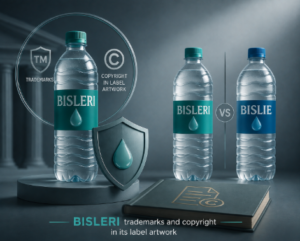 Case: Bisleri International Private Limited v. Belaguli Mahalingegowda Kirankumar, Proprietor of Kalabyraveshwara Mineral Water Industry
Order dated: 7 August 2026
Court: Bombay High Court
Relevant Provisions: Trade Marks Act, 1999; Copyright Act, 1957; Clause XIV of the Letters Patent (Bombay); Order XXXIX Rule 7 and Order XL Rule 1 of the Code of Civil Procedure, 1908.
Case Background
Bisleri International Private Limited, proprietor of the registered BISLERI trademark for packaged drinking water and related services, initiated infringement proceedings against the Defendant for manufacturing and marketing packaged drinking water under the mark “BISLIE.”
Bisleri also relied on its copyright registrations in the original artistic works appearing on its BISLERI labels, including registrations dating from 2009 and 2025.
During a market investigation conducted in Channarayapattana, Karnataka, in May 2026, Bisleri traced the impugned BISLIE products to the Defendant’s manufacturing unit. Bisleri alleged that the Defendant had adopted BISLIE by merely deleting the sixth letter “r” from BISLERI and interchanging the positions of the letters “e” and “i.”
It was further alleged that the Defendant had copied Bisleri’s colour scheme, placement of features, get-up, layout, style, artwork and overall trade dress, and had adopted a bottle design substantially similar to the BISLERI bottle.
On 11 June 2026, the Bombay High Court granted an ex-parte ad-interim injunction and appointed a Court Receiver with powers to search the Defendant’s premises and seize the impugned goods and related manufacturing and packaging material. The Receiver subsequently carried out the search and seizure exercise.
Bisleri thereafter sought confirmation of the earlier relief and further protection against use of the impugned trade dress and bottle design.
Issues for Consideration
The Court considered:
- Whether BISLIE was deceptively similar to the registered trademark BISLERI;
- Whether the impugned label and artwork infringed Bisleri’s copyright in its registered artistic works;
- Whether the Defendant’s trade dress and bottle design amounted to passing off;
- Whether the earlier ex-parte injunction and appointment of the Court Receiver should be confirmed; and
- Whether additional interim protection covering the impugned trade dress and bottle shape was warranted.
Submissions of the Parties
Plaintiff’s Submissions
Bisleri submitted that the Defendant had made only minor alterations to its registered trademark to arrive at BISLIE and that the overall commercial impression remained deceptively similar to BISLERI.
It further contended that the Defendant had reproduced the colour scheme, placement of features, get-up, layout, style and representation of Bisleri’s registered label artwork.
Bisleri also relied on the similarity between the rival bottle designs and trade dress and argued that the Defendant’s overall product presentation was capable of passing off its goods as those of Bisleri or as being commercially associated with Bisleri.
Bisleri relied additionally on the Additional Special Receiver’s Report prepared following execution of the search and seizure order.
Defendant’s Submissions
Despite service, the Defendant did not appear before the Court and did not file an affidavit in reply. The allegations in the Plaint, Interim Application and Leave Petition therefore remained uncontroverted.
Observations of the Court
The Court found a strong prima facie case in favour of Bisleri.
On comparison of the marks, the Court specifically noted that BISLIE had been formed by deleting the letter “r” from BISLERI and interchanging the positions of “e” and “i.” It therefore held that BISLIE was prima facie deceptively similar to BISLERI. The Court further observed that the Defendant’s packaging adopted a colour scheme, placement of features, get-up, layout, style, representation and trademark identical with or substantially similar to Bisleri’s registered labels and original artistic works.
The Court also considered the Defendant’s use of the impugned trade dress and bottle design. It accepted Bisleri’s case that use of a substantially similar or obvious imitation of its bottle shape and overall product presentation was capable of passing off the Defendant’s goods as those of Bisleri. Importantly, the Additional Special Receiver’s Report was found to support the allegations made in the Plaint and Interim Application. Since the Defendant had neither appeared nor filed a reply, the material placed by Bisleri remained unrebutted.
Relief Granted
The Bombay High Court:
- Restrained the Defendant from manufacturing, distributing, packaging, stocking, marketing, selling or otherwise using BISLIE, or any mark deceptively similar to BISLERI, in relation to packaged drinking water and similar goods;
- Restrained use of the impugned artwork, colour scheme, layout, get-up and other artistic elements identical with or substantially similar to Bisleri’s registered original artistic works;
- Restrained use of the impugned BISLIE trade dress or any deceptively similar trade dress so as to pass off the Defendant’s goods as those of Bisleri;
- Restrained use of the impugned bottle design or shape, or any design substantially similar to or an obvious imitation of Bisleri’s bottle design;
- Confirmed the earlier appointment of the Court Receiver and the search and seizure relief;
- Allowed the Leave Petition; and
- Disposed of the Interim Application and Receiver’s Report in terms of the relief granted.
Conclusion
The decision confirms that minor spelling alterations will not avoid a finding of deceptive similarity where the impugned mark retains the overall commercial impression of a registered trademark.
More importantly, the order demonstrates that infringement and passing-off protection may extend beyond the brand name itself to the label artwork, colour scheme, trade dress and bottle shape where the overall presentation of the competing product closely imitates that of the trademark proprietor.
The case also highlights the evidentiary significance of a Court Receiver’s search and seizure report, particularly where the defendant, despite service, does not appear or controvert the material placed on record.
UNDISCLOSED YOUTUBE PRIOR ART TRIGGERS FRESH OPPOSITION REVIEW: BOMBAY HIGH COURT ORDERS REMAND.
 Case: Ashit Padhya v. Assistant Controller of Patents and Designs, Mumbai & Ors.
Order dated: 30 July 2026
Court: Bombay High Court
Relevant Provision: Section 25(2) of the Patents Act, 1970
Case Background
The dispute arose from post-grant opposition proceedings concerning a patent held by the Petitioner, Ashit Padhya.
In the post-grant opposition proceedings, the Controller passed an order revoking the granted patent and, while doing so, relied upon a YouTube video as prior art that had not previously been furnished to the Patentee. The video was disclosed for the first time in the revocation order itself, thereby denying the Patentee an opportunity to address the material before it was relied upon. The resulting breach of natural justice was subsequently acknowledged in the order passed in review proceedings.
Despite this, further reliance was sought to be placed on additional YouTube videos and related material. The Petitioner therefore approached the Bombay High Court challenging the manner in which such material had been introduced and relied upon.
During the hearing, the Petitioner suggested that all YouTube videos proposed to be relied upon, together with any connected material, should first be placed before the Opposition Board for independent consideration in accordance with the procedure applicable to post-grant opposition proceedings. The Controller of Patents accepted this proposal.
The matter therefore came before the Court to determine the appropriate procedure for reconsideration of the opposition, including disclosure of all relied-upon material, consideration by the Opposition Board, and a fresh hearing before a competent authority.
Issues for Consideration
The principal issues before the Court were:
- Whether prior-art material relied upon by the Patent Office could be considered without first furnishing it to the patentee;
- How the YouTube videos and any related material should be considered in the pending post-grant opposition;
- Whether the matter should return to the same Controller who had previously considered it; and
- What would be the status of the patent during the remanded opposition proceedings.
Observations of the Court
The Court found it appropriate that all YouTube videos relied upon as prior art be first placed before the Opposition Board for an independent assessment and recommendation.
Importantly, the Court directed that every piece of material which the Controller’s Office proposes to rely upon must be furnished to the Petitioner and also placed before the Opposition Board. This would ensure that the parties have an opportunity to address the material before it forms the basis of any decision.
The Opposition Board was directed to independently consider the material and make its recommendations in accordance with the applicable post-grant opposition procedure.
The Court further noted that the proceedings had already been considered twice by the same Controller. Accordingly, after receiving the Opposition Board’s recommendations, the matter was directed to be placed before a different competent authority in the Controller’s Office for a fresh hearing and decision, uninfluenced by the earlier proceedings.
The original opponents were also permitted to address the Opposition Board and the Controller regarding the YouTube videos and any additional material connected with those videos, including material relating to the source of the video content.
Relief Granted
The Bombay High Court:
- Set aside the impugned order and remanded the matter for fresh consideration;
- Directed that all YouTube videos relied upon, together with any connected material, be placed before the Opposition Board;
- Directed that any material proposed to be relied upon by the Patent Office must first be furnished to the Petitioner;
- Directed the Opposition Board to independently consider the material and provide its recommendations;
- Directed that, after receiving those recommendations, a different competent authority hear all parties afresh and pass a fresh order in accordance with law;
- Clarified that the original opponents would also be entitled to make submissions on the videos and connected material; and
- Clarified that, during the remand, the patent would retain the status of a granted patent subject to pending opposition proceedings.
The Court specifically directed that the defined scope of the remand be strictly adhered to.
Conclusion
The order reinforces a basic requirement of natural justice in post-grant opposition proceedings: any material proposed to be relied upon against the patentee must first be furnished to the patentee and considered through the prescribed opposition procedure.
The direction that the matter be heard by a different Controller further ensures that the remanded proceedings are conducted independently and without influence from the earlier revocation and review proceedings.
ACTUAL USE OVER REGISTRATION: DELHI HIGH COURT RESTRAINS HAVAI AGAINST HAVELLS
 Case: Havells India Limited & Anr. v. Havai Home Products Private Limited & Anr.
Judgment dated: 25 August 2026
Court: Delhi High Court
Relevant Provisions: Sections 2(1)(zg), 27(2), 28(3), 29 and 34 of the Trade Marks Act, 1999; Order XXXIX Rules 1 and 2 of the Code of Civil Procedure, 1908.
Case Background
Havells India Limited and its group entity instituted proceedings against the Defendants for use of the mark “HAVAI” and related device marks in relation to electrical goods including air coolers, pedestal fans and immersion rods.
The Plaintiffs are proprietors of the HAVELLS trademark, which has been used since 1942 and has registrations dating back to 1955. HAVELLS has also been recognised by the Delhi High Court as a well-known trademark and is included in the Trade Marks Registry’s list of well-known marks.
The Defendants held registrations for the word mark HAVAI in several classes. However, the Plaintiffs contended that the marks actually used in the market materially differed from the registered version. In particular, the final letter “I” in HAVAI was stylised without a serif in a manner that made it resemble the letter “L”, thereby causing the mark to be perceived and pronounced as “Ha-va-L”, bringing it closer to HAVELLS.
The Plaintiffs further alleged that the Defendants had adopted device marks using black-and-white and red-and-white colour schemes and get-up similar to those associated with HAVELLS. The Defendants were also selling spare parts and cooler covers referring to “HAVELLS SPARES”, although those references were subsequently removed pursuant to an undertaking before the Court.
The Plaintiffs therefore sought an interim injunction restraining use of the impugned HAVAI marks on the ground of infringement and passing off.
Issues for Consideration
The Court considered:
- Whether an action for passing off could be maintained against a proprietor holding registration for the mark HAVAI;
- Whether the marks actually used by the Defendants were deceptively similar to HAVELLS;
- Whether stylisation of the final letter “I” in HAVAI created a likelihood of consumers reading or pronouncing the mark as “HAVAL”;
- Whether similarity in the rival goods, trade channels and overall presentation increased the likelihood of confusion; and
- Whether the Plaintiffs had established the requirements for grant of an interim injunction.
Submissions of the Parties
Plaintiffs’ Submissions
The Plaintiffs contended that HAVELLS had acquired substantial goodwill and reputation through decades of continuous and extensive use, significant sales, advertising and promotion, and a strong domestic and international presence. In support, they relied, inter alia, on a turnover of approximately Rs. 18,550 crores and advertising expenditure of approximately Rs. 528 crores for the financial year 2023–2024. HAVELLS had also been recognised as a well-known trademark.
The Plaintiffs submitted that although Defendant No.1 held a registration for HAVAI, the mark actually used on the Defendants’ products was materially different from the registered form. In particular, the final letter “I” was stylised in a manner that could be perceived as “L”, causing HAVAI to be read or pronounced closer to HAVELLS and thereby creating visual and phonetic similarity between the rival marks.
They further argued that the likelihood of confusion was heightened because the parties dealt in identical or closely related electrical goods, including fans, air coolers and immersion rods, and catered to overlapping consumers and trade channels. The Defendants had also adopted device marks with colour combinations and overall get-up similar to those used with the HAVELLS marks.
The Plaintiffs therefore submitted that the Defendants’ registration of HAVAI could not defeat an action for passing off, since their prior use and goodwill in HAVELLS constituted superior common-law rights. According to the Plaintiffs, the manner in which HAVAI was actually presented in the marketplace amounted to a misrepresentation likely to create an association with HAVELLS and enable the Defendants to benefit from the Plaintiffs’ established goodwill and reputation.
Defendants’ Submissions
The Defendants contended that Defendant No.1 was the registered proprietor of the mark HAVAI and was therefore entitled to use the same in relation to the goods covered by its registrations.
They submitted that HAVAI and HAVELLS were visually, structurally and phonetically distinct and that there was no likelihood of confusion between the rival marks. The Defendants further explained that the mark HAVAI had been adopted from the word “HAVA,” meaning air, having regard to their business in air-related products.
It was also argued that, since Defendant No.1 held valid registrations for HAVAI, an action for trademark infringement could not ordinarily be maintained by one registered proprietor against another registered proprietor. The Defendants further contended that the Plaintiffs had produced no evidence of actual consumer confusion, deception or misrepresentation sufficient to establish passing off.
The Defendants additionally relied on the anti-dissection principle, submitting that the rival marks must be compared as a whole and not by isolating individual letters, syllables or constituent elements.
Observations of the Court
Registration Is No Defence to Passing Off
The Court held that registration of HAVAI did not bar an action for passing off.
Relying on S. Syed Mohideen v. P. Sulochana Bai, the Court reiterated that passing off is a common-law remedy independent of statutory trademark registration. Rights arising from prior use and goodwill may therefore prevail even against a subsequently registered proprietor.
The Court noted that the classical requirements for passing off are goodwill, misrepresentation and damage.
The Court was also unpersuaded by the explanation that HAVAI had been derived from ‘HAVA’, meaning air, noting that this did not explain the departure from the registered form of the mark and that the Defendants also sold products such as immersion rods, which were unrelated to air-based products.
Actual Market Use Was More Important Than the Registered Form
A significant distinction was drawn between Defendant No.1’s registered word mark and the form actually used in commerce.
The registered HAVAI mark ended with a clearly identifiable serifed “I”. However, the Defendants had altered the presentation of the final letter so that it could visually resemble an “L”.
The Court observed that consumers encounter the mark as actually presented in the marketplace, rather than the form appearing on the Trade Marks Register.
The Court found no satisfactory explanation for why the Defendants had moved away from the form of their own registered trademark.
Stylised “I” Created Phonetic Similarity
The Court observed that the registered HAVAI mark might ordinarily be pronounced as “Ha-va-ee” or “Ha-vai” and may therefore not be phonetically similar to HAVELLS.
However, once the serif of the final “I” was removed, the letter could be perceived as “L”, causing the impugned mark to be read or pronounced as “Ha-va-L”.
The Court characterised this alteration as a deliberate attempt to move closer to HAVELLS and create an association in the minds of consumers.
It therefore held that the overall commercial impression created by the impugned HAVAI marks was deceptively similar to HAVELLS.
Similarity Extended to Device Marks and Colour Scheme
The Court further noted that the Defendants had adopted device marks in which HAVAI remained the dominant element and had also used black-and-white and red-and-white colour combinations and get-up similar to the Plaintiffs’ HAVELLS device marks.
This reinforced the Court’s prima facie conclusion that the Defendants sought to create an association with HAVELLS.
Identity of Goods and Initial-Interest Confusion
The Court found that the likelihood of confusion was enhanced because both parties dealt in substantially identical goods, including air coolers, fans and immersion rods.
Given the deceptive similarity of the marks, identity of goods and substantial reputation of HAVELLS, the Court applied the principle of initial-interest confusion.
It held that even if a consumer ultimately discovers the true source of the goods, confusion may arise at the stage when the consumer first encounters the Defendant’s products.
The Court therefore found that the three ingredients of passing off—goodwill, misrepresentation and likelihood of damage—were prima facie established.
Relief Granted
The Delhi High Court held that:
- HAVELLS had substantial goodwill and reputation and was a recognised well-known trademark;
- Registration of HAVAI did not provide a defence against the Plaintiffs’ passing-off claim;
- The HAVAI marks actually used by the Defendants differed materially from their registered mark;
- Stylisation of the final “I” so that it could resemble “L” made the impugned mark deceptively similar to HAVELLS;
- Similarity of the rival goods and the Defendants’ use of similar device marks, colour schemes and get-up increased the likelihood of confusion;
- The Plaintiffs had established a prima facie case, balance of convenience and likelihood of irreparable injury.
Accordingly, the Defendants were restrained, during the pendency of the suit, from selling, marketing, advertising or offering goods under the impugned HAVAI word and device marks, or any other mark deceptively similar to HAVELLS, so as to amount to passing off.
The Court clarified that its observations were prima facie and would not affect the final adjudication of the suit.
Conclusion
The decision reinforces that trademark registration does not provide an absolute defence to passing off, particularly where a prior user has established superior goodwill and reputation.
More significantly, the Court looked beyond the mark appearing on the Register and examined how the mark was actually presented to consumers. The deliberate stylisation of “I” so that it could be perceived as “L”, together with identical goods and similar colour schemes and get-up, was sufficient to establish a prima facie likelihood of confusion.
The ruling therefore highlights that subtle typographical alterations may attract passing-off liability where their practical effect is to bring a later mark closer to the market identity of a well-known brand.
ONLINE REACH, TERRITORIAL LIMITS: DELHI HIGH COURT REFERS IP JURISDICTION QUESTIONS TO LARGER BENCH
 Case: Hindustan Unilever Limited v. Kwick Living (I) Private Limited
Court: Delhi High Court
Relevant Provisions: Section 20(c) of the Code of Civil Procedure, 1908; Section 134(2) of the Trade Marks Act, 1999; Section 62(2) of the Copyright Act, 1957.
Case Background
Hindustan Unilever Limited (“HUL”) instituted a commercial suit against Kwick Living (I) Private Limited (“Kwick Living”) concerning its advertising campaign “War on What’s Hidden.” HUL alleged that the campaign disparaged its VIM and SURF EXCEL products through comparative claims disseminated across hoardings, YouTube, Instagram and Kwick Living’s website.
Before considering the merits of the disparagement claim, the Court was required to address Kwick Living’s objection to the territorial jurisdiction of the Delhi High Court. Both HUL and Kwick Living have their registered and principal offices in Mumbai, and the impugned hoarding specifically identified in the plaint had also been photographed in Mumbai.
HUL nevertheless asserted jurisdiction in Delhi on the basis that the impugned campaign was accessible to consumers in Delhi through online platforms and that Kwick Living’s products were commercially available in the jurisdiction.
While considering the objection, the Court found significant divergence in the existing jurisprudence on the interplay between Section 20 of the Code of Civil Procedure, 1908, Section 134(2) of the Trade Marks Act, 1999 and Section 62(2) of the Copyright Act, 1957. Section 20 CPC generally permits a suit where the defendant resides or carries on business, or where the cause of action arises, while Sections 134(2) and 62(2) additionally permit trademark and copyright plaintiffs to sue where they themselves reside or carry on business. The difficulty in online disputes is determining when internet accessibility, targeted advertising or online transactions create a sufficient cause of action in a particular forum. The Court therefore considered that authoritative clarification was required on how these provisions operate together in cases involving digital activity.
Issues for Consideration
The Court considered:
- Whether online accessibility of an advertisement or commercial website in Delhi is sufficient to constitute part of the cause of action under Section 20(c) CPC;
- Whether a corporate plaintiff may invoke Section 134(2) of the Trade Marks Act or Section 62(2) of the Copyright Act to sue at a place other than its principal office when part of the cause of action has arisen at the principal-office location; and
- What test should govern territorial jurisdiction in IP disputes involving online advertisements, transactions and digital platforms.
Submissions of the Parties
Plaintiff’s Submissions
HUL contended that jurisdiction was independently available under Section 20(c) CPC, since the impugned advertisements were accessible in Delhi through YouTube and Instagram and Kwick Living’s website facilitated sale of products in Delhi.
It further submitted that Section 134(2) of the Trade Marks Act and Section 62(2) of the Copyright Act provided additional jurisdiction since HUL carried on business in Delhi.
HUL also argued that use of a trademark through advertisements could give rise to a cause of action wherever such use occurred and that the restriction recognised in Indian Performing Rights Society Ltd. v. Sanjay Dalia did not displace its independent case under Section 20(c) CPC.
Defendant’s Submissions
Kwick Living contended that the plaint disclosed no specific act giving rise to a cause of action in Delhi and that the only identified physical advertisement was situated in Mumbai.
It further relied on the fact that both parties had their registered offices in Mumbai, arguing that HUL could not invoke another forum when its principal office and a substantial part of the alleged cause of action were situated in Mumbai.
Kwick Living also relied on Banyan Tree Holding (P) Ltd. v. A. Murali Krishna Reddy to contend that mere accessibility of a website within a jurisdiction is insufficient and that some degree of purposeful targeting or availment of the forum must be shown.
Observations of the Court
The Court found that existing precedents disclosed two significant and unresolved areas of conflict.
First, there was uncertainty regarding the relationship between the additional jurisdiction conferred upon IP owners under Section 134(2) of the Trade Marks Act and Section 62(2) of the Copyright Act, and the restriction recognised by the Supreme Court in Sanjay Dalia where the plaintiff’s principal office and part of the cause of action are situated at the same place.
Second, the Court identified divergent approaches concerning internet-based jurisdiction.
In Banyan Tree, the Delhi High Court had required purposeful targeting of the forum and held that mere website accessibility was insufficient. In contrast, decisions such as World Wrestling Entertainment treated an interactive website capable of concluding commercial transactions as sufficient to establish business presence in the jurisdiction. Subsequent decisions, including Kohinoor Seed Fields and Nilesh Girkar, were also noted to reflect broader approaches to online accessibility and transactions.
The Court observed that if mere accessibility of an online advertisement or website were sufficient, a corporation could potentially institute proceedings in almost any jurisdiction in the country. At the same time, the conflicting Division Bench authorities could not appropriately be reconciled by a Single Judge.
The Court therefore considered it necessary that the issue be authoritatively settled by a Larger Bench.
Questions Referred to the Larger Bench
The Court referred, in substance, the following questions:
- Whether territorial jurisdiction in IP suits is governed by Section 20 CPC, Section 134 of the Trade Marks Act and Section 62 of the Copyright Act independently or through an interplay of these provisions, and how such provisions are to operate together.
- Whether a corporate plaintiff is required to institute proceedings at the place of its principal or registered office when part of the cause of action has arisen at that place, notwithstanding that it carries on business elsewhere.
- What jurisdictional test should apply to online transactions and internet-based activity in IP disputes, particularly in view of the differing approaches adopted in Banyan Tree, World Wrestling Entertainment and Kohinoor Seed Fields.
The Registry was directed to place the matter before the Chief Justice for constitution of an appropriate Larger Bench.
Conclusion
The decision does not determine HUL’s underlying disparagement claim. Instead, it places before a Larger Bench a broader question that has significant consequences for online trademark, copyright and comparative-advertising disputes.
The reference is particularly important because digital advertisements and e-commerce activity may be accessible across India, while territorial jurisdiction traditionally requires a meaningful connection between the dispute and the chosen forum.
The Larger Bench’s determination is therefore expected to clarify whether mere online accessibility, transactional capability or purposeful targeting should constitute the relevant threshold for territorial jurisdiction, and how those principles must operate alongside the special jurisdiction provisions of the Trade Marks Act and Copyright Act.
PRIOR ART GAPS IN DRUG COMBINATION ANALYSIS: DELHI HIGH COURT ORDERS FRESH REVIEW.
 Case: Array BioPharma Inc. v. Deputy Controller of Patents and Designs
Judgment dated: 23 July 2026
Court: Delhi High Court
Relevant Provisions: Sections 2(1)(ja), 3(d), 3(i), 10(4)(c), 10(5), 15 and 117A of the Patents Act, 1970.
Case Background
The appeal was filed under Section 117A of the Patents Act, 1970 against an order dated 30 June 2023 refusing Patent Application No. 450/DELNP/2015 titled “Pharmaceutical Combination Comprising a B-Raf Inhibitor, an EGFR Inhibitor and Optionally a PI3K Alpha Inhibitor.”
The claimed invention relates to a pharmaceutical combination comprising Encorafenib, a B-Raf inhibitor, together with Cetuximab or Erlotinib, as EGFR inhibitors, and optionally Alpelisib, a PI3K-α inhibitor, for separate, simultaneous or sequential administration.
The Controller refused the application for lack of inventive step under Section 2(1)(ja) and non-patentability under Sections 3(d) and 3(i). Objections concerning claim clarity and scope under Sections 10(4)(c) and 10(5) were also maintained.
The Applicant challenged the refusal, relying particularly on clinical data in the complete specification showing improved tumour response from the claimed dual and triple combinations and contending that the cited prior art did not disclose or suggest the specific claimed combinations.
Issues for Consideration
The Court considered:
- Whether the claimed pharmaceutical combination involved an inventive step over prior arts D1-D4;
- Whether the claimed combination fell within the exclusion under Section 3(d);
- Whether the expression “for simultaneous, separate or sequential administration” converted the product claim into a method of treatment barred by Section 3(i);
- Whether the clinical data demonstrating therapeutic effects had been properly considered; and
- Whether the objections concerning clarity and scope under Sections 10(4)(c) and 10(5) were adequately reasoned.
Submissions of the Parties
Appellant’s Submissions
The Appellant contended that the invention was directed to a specific pharmaceutical combination, rather than merely placing known drugs together.
It relied on the data in Examples 2 and 3 to show that the dual combination of Encorafenib and Cetuximab reduced tumour progression to 12%, compared with 95% for Encorafenib monotherapy and 88% for Cetuximab monotherapy. The triple combination further resulted in -2% tumour progression, indicating tumour regression, which was asserted to demonstrate an unexpected technical and synergistic effect.
The Appellant further submitted that none of D1-D4 disclosed the specific claimed dual combination of Encorafenib with Cetuximab/Erlotinib, or the claimed triple combination additionally comprising Alpelisib.
On Section 3(d), it was argued that the claimed invention comprised independent active pharmaceutical agents having distinct chemical identities and mechanisms of action, rather than a new form or derivative of a single known substance.
As regards Section 3(i), the Appellant submitted that Claim 1 was a product claim directed to a pharmaceutical combination. The words “simultaneous, separate or sequential administration” merely described how the combination could be administered and did not convert the claim into a therapeutic method or treatment protocol.
Respondent’s Submissions
The Respondent contended that the claimed subject matter was in substance a treatment regimen involving known drugs and was therefore excluded under Section 3(i). Particular reliance was placed on the dosing schedules and clinical trial protocols disclosed in the specification.
It was further argued that all the individual compounds were already known and that the claimed combination resulted from combining the teachings of D1-D4. According to the Respondent, the prior art provided sufficient motivation and reasonable expectation of success for combining B-Raf, EGFR and PI3K inhibitors.
The Respondent also argued that the claimed subject matter represented an attempt at evergreening and raised public-interest concerns regarding monopolisation of cancer-treatment combinations involving independently available drugs.
Observations of the Court
Prior Art Did Not Disclose the Specific Claimed Combination
The Court examined D1-D4 individually and found that, although different components or general classes of inhibitors were disclosed across the cited documents, none disclosed the specific combination claimed in the application.
D1 disclosed Encorafenib and referred generally to combination therapy, including PI3K inhibitors, but did not disclose the claimed PI3K-α inhibitor.
D2 disclosed EGFR inhibitors including Erlotinib and Cetuximab and combinations of B-Raf and EGFR inhibition, but did not disclose Encorafenib as the B-Raf inhibitor.
D3 disclosed a B-Raf/PI3K combination, but involved different compounds—Dabrafenib rather than Encorafenib and a PI3K inhibitor different from Alpelisib.
D4 discussed combination of EGFR and PI3K/Akt pathway inhibition but did not identify the specific EGFR and PI3K-α inhibitors claimed.
The Court therefore observed that the refusal order had failed to explain how a person skilled in the art would be motivated to select and combine the specific claimed compounds.
Technical Advancement Required Proper Consideration
The Court also examined the experimental data relied upon by the Applicant.
It noted that the Controller had compared the Applicant’s therapeutic data with synergy reported in D2 and D3. However, the compounds used in those prior-art experiments were not the same as the specific compounds claimed in the application.
The Court found that the refusal order did not adequately address this distinction and was therefore not satisfied with the reasoning adopted on inventive step.
Section 3(d): Known Substance Not Identified
The Controller had held that the pharmaceutical combination fell within Section 3(d) because similar combinations were allegedly known from the prior art.
The Court, however, noted that the refusal order did not identify the particular “known substance” of which the claimed combination was supposedly a new form or derivative.
Referring to Topotarget UK Ltd. v. Controller General of Patents and Designs, the Court observed that a combination of two separate active drugs cannot simply be treated as derivatives of one another for the purpose of Section 3(d).
Accordingly, the Court was unable to agree with the reasoning adopted by the Controller under Section 3(d).
Section 3(i): Product Claim Cannot Be Converted Into Treatment Method Merely by Administration Language
The Court found that Claim 1 was framed as a claim to a pharmaceutical combination and not as a process, dosing protocol or method of treatment.
It held that the expression “for simultaneous, separate or sequential administration” functioned as a descriptor of the claimed combination and did not itself impose a particular treatment protocol or method step.
The Court further observed that clinical trials and dosing schedules appearing in working examples demonstrate the practical implementation and workability of an invention, but do not define the scope of the patent claims.
Accordingly, the Controller’s reliance on treatment schedules in the specification to characterise the product claim as a method of treatment was considered misplaced.
Clarity Objection Lacked Reasoning
The Court also found that the objection under Sections 10(4)(c) and 10(5) merely stated that the claims lacked clarity and failed to define significant technological contribution, without providing adequate reasons.
Since the reasoning on technical advancement itself required reconsideration, the clarity objection was also directed to be reconsidered.
Relief Granted
The Delhi High Court:
- Remanded the patent application to the Controller for de novo reconsideration of the objections raised;
- Directed that the Applicant be granted an opportunity of hearing;
- Directed the Controller to dispose of the application within six months from receipt of the order; and
- Clarified that the Controller must decide the application on its own merits and without being influenced by the Court’s observations.
Importantly, the Court did not direct grant of the patent, but remanded the application for fresh examination and determination.
Conclusion
The decision emphasises that an inventive-step analysis for pharmaceutical combinations must identify how the prior art would actually motivate a skilled person to select and combine the specific claimed active agents, rather than relying merely on generic disclosures of drug classes or combination therapies.
It further clarifies that Section 3(d) cannot be applied without identifying the relevant known substance, and that independent active pharmaceutical agents cannot automatically be treated as derivatives of one another.
Equally significant is the Court’s treatment of Section 3(i): administration language or clinical examples do not by themselves convert a product claim for a pharmaceutical combination into a method of treatment. The character of the claim must be determined from what is actually claimed, while working examples principally demonstrate workability rather than define claim scope.