
SPEAKING ORDERS MANDATORY: UNSUPPORTED “COMMON GENERAL KNOWLEDGE” CANNOT DEFEAT PATENTABILITY
 Case: Deepak Nitrite Limited v. Assistant Controller of Patents and Designs (6 July 2026)
Sections 2(1)(ja) & 15, Patents Act, 1970
The matter concerned the rejection of Patent Application No. 202021019409 titled “A Free-Flowing Food Grade Sodium Nitrite and Production Method Thereof” under Section 15 of the Patents Act on the ground that the claimed invention lacked an inventive step under Section 2(1)(ja). The Petitioner challenged the refusal order, contending that the Assistant Controller had rejected both the product and process claims without undertaking the reasoned inventive-step analysis mandated under law, leading to the present appeal.
Submissions of the Petitioner
The Petitioner contended that the refusal order failed to conduct a proper inventive-step analysis for both the product and process claims. It argued that the Controller rejected the product claims by merely stating that the claimed impurity profile was based on “common general knowledge” without identifying any supporting source or prior art. As regards the process claims, the Petitioner submitted that the Controller examined only an isolated filtration step instead of considering the integrated process as a whole. Relying on judicial precedents, the Petitioner argued that inventive step must be assessed through a reasoned analysis considering the invention in its entirety.
Submissions of the Respondents
The Respondent defended the refusal order, contending that the application had been examined after due consideration and that no interference was warranted. However, during the hearing, the Respondent fairly conceded that the impugned order did not contain an independent inventive-step analysis of the process claims in the manner required by judicial precedents and agreed that those claims could be remanded for fresh consideration.
With regard to the product claims, the Respondent maintained that the difference in impurity profile was attributable to common general knowledge and therefore did not involve an inventive step. However, when questioned by the Court regarding the source or basis of such common general knowledge, the Respondent was unable to identify any supporting material from the record.
Court’s Analysis
The Court held that a Controller exercising quasi-judicial powers under Section 15 cannot reject a patent application merely by invoking “common general knowledge” without identifying the source from which such knowledge is derived. Relying upon the decision in AGFA NV v. Assistant Controller of Patents and Designs, the Court observed that the Controller must disclose the specific source of the asserted common general knowledge and establish that it existed prior to the priority date of the patent application. A bald assertion, unsupported by evidence or reasoning, was held to be arbitrary, contrary to the principles of natural justice, and incapable of sustaining a refusal order.
The Court further observed that the impugned order failed to analyse the invention as a whole, ignored the Applicant’s submissions, and lacked a reasoned discussion on inventive step. It emphasised that speaking orders are mandatory and that mere reproduction of objections, prior art references, or conclusions without an independent chain of reasoning does not satisfy the statutory duty cast upon the Controller. The Court also expressed concern over the recurring pattern of mechanical and inadequately reasoned orders passed by the Patent Office, noting that repeated remands unnecessarily burden applicants, the Patent Office, and the judiciary.
Conclusion
The Court allowed the Petition, set aside the impugned refusal order, and remanded the patent application for fresh consideration by the Controller. It directed that the application be decided through a reasoned and speaking order after properly considering the Applicant’s submissions, the cited prior art, the statutory requirements, and the principles governing inventive-step analysis. The Court further directed that the reconsideration be completed within twelve weeks from communication of the order.
TECHNICAL FEATURES CANNOT BE REJECTED AS MERE DESIGN: NON-SPEAKING PATENT REFUSAL SET ASIDE
 Case: Titan Company Limited – Patent Application No. 202041004928 (11 December 2025)
Section 3(l) & Section 15, Patents Act, 1970
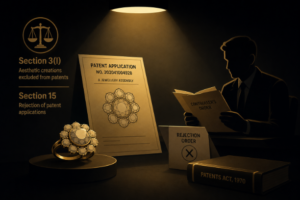
The matter concerned the rejection of Indian Patent Application No. 202041004928 titled “A Jewellery Assembly” under Section 15 of the Patents Act on the ground that the claimed invention was merely an aesthetic creation falling within Section 3(l) and was more appropriately protectable under the Designs Act. The Appellant challenged the refusal, contending that the invention related to a structural configuration of gemstones that achieved the technical effect of reducing manufacturing costs while creating the appearance of a larger gemstone. The appeal therefore required the Court to determine whether the Controller had properly examined the technical features of the claimed invention before rejecting the application.
Submissions of the Petitioner
The Appellant contended that the Controller had erroneously focused only on the aesthetic appearance of the jewellery while ignoring its technical and structural features. It was argued that the claimed arrangement of multiple gemstones produced a technical advantage by reducing the use of expensive large diamonds and lowering manufacturing costs. The Appellant further submitted that the impugned order failed to consider its written submissions and the judicial precedents distinguishing patentable technical features from mere design elements.
Submissions of the Respondents
The Respondent supported the impugned order, submitting that the claimed invention primarily related to the appearance of the jewellery and therefore constituted a design rather than a patentable invention. It was argued that the Controller had correctly concluded that the invention did not solve any technical problem and merely involved a workshop improvement lacking patentability.
Court’s Analysis
The Court observed that the impugned order did not adequately consider the Appellant’s written submissions explaining the technical problem and solution underlying the invention. It held that while rejecting a patent application, the Controller is required to analyse the claims, examine all objections raised during prosecution, and provide a reasoned order addressing the Applicant’s contentions. The Court further noted that if the Controller proposed to reject the invention on the ground that it lacked any technical solution, the Applicant ought to have been afforded an opportunity to address that finding. Since the impugned order failed to demonstrate proper application of mind and did not discuss the technical aspects relied upon by the Appellant, it could not be sustained.
Conclusion
The Court set aside the impugned refusal order and remanded the patent application to the Controller for fresh consideration. It directed that the application be reconsidered after properly examining the Appellant’s submissions, analysing the claimed technical features, and passing a reasoned order in accordance with law.
Subsequent Development (Order dated 08 July 2026): Pursuant to the High Court’s remand, the Controller reconsidered the application and passed a fresh reasoned order on 08 July 2026. While acknowledging that the claimed jewellery assembly was novel and involved an inventive step over the cited prior art, the Controller again refused the application under Section 15 read with Section 3(l), holding that the invention merely created the aesthetic illusion of a larger gemstone without providing any objectively measurable technical contribution or solving a technical problem. Relying on the principle that compliance with Sections 2(1)(j) and 2(1)(ja) alone is insufficient where the invention falls within a statutory exclusion, the Controller concluded that the claimed subject matter remained an aesthetic creation and was therefore not patentable under the Patents Act.
TERRITORIAL JURISDICTION NOT ESTABLISHED: MERE WEBSITE ACCESSIBILITY INSUFFICIENT
 Case: SML Limited v. M/s Happy Agro Chemicals (2 July 2026)
Section 104, and section 20 of Patents Act, 1970, Code of Civil Procedure, 1908
The matter concerned whether the Delhi High Court could exercise territorial jurisdiction over a patent infringement suit where the defendants’ products were allegedly accessible through online platforms. The Plaintiff instituted the suit alleging patent infringement and asserted that the Defendants were carrying on business within the jurisdiction of the Court through their websites and online marketplaces. The Defendants disputed the maintainability of the suit, contending that no cause of action had arisen within Delhi, leading the Court to examine whether territorial jurisdiction had been established.
Submissions of the Petitioner
The Plaintiff contended that the Defendants’ products were advertised and accessible through their websites and online platforms, which was sufficient to confer territorial jurisdiction. It further argued that a trap purchase demonstrated the availability of the products and relied upon previous judicial decisions to contend that the suit was maintainable before the Delhi High Court.
Submissions of the Respondents
The Defendants argued that mere accessibility of a website within Delhi did not establish territorial jurisdiction in the absence of any commercial transaction or evidence showing that products were sold or delivered within the jurisdiction. They further submitted that the Plaintiff had failed to produce any material demonstrating that the Defendants had customers or conducted business in Delhi.
Court’s Analysis
The Court held that mere accessibility of a website is insufficient to confer territorial jurisdiction unless it is accompanied by evidence showing that the Defendant purposefully targeted customers within the jurisdiction and carried out commercial transactions there. Applying the test of “purposeful availment” laid down in Banyan Tree, the Court found that the Plaintiff had failed to establish any sale or delivery of the Defendants’ products in Delhi. The Court further observed that isolated trap purchases cannot be used to create jurisdiction and that commercial-scale sales within the territorial jurisdiction must be demonstrated. It also distinguished the decisions relied upon by the Plaintiff, holding that those cases arose on different facts and did not support the Plaintiff’s claim of jurisdiction.
Conclusion
The Court held that the Plaintiff had failed to establish territorial jurisdiction as there was no evidence that the Defendants had purposefully availed themselves of the Delhi market through commercial transactions. Mere online accessibility of the Defendants’ websites and isolated trap purchases were held to be insufficient to confer jurisdiction. Consequently, the Court declined to entertain the suit for want of territorial jurisdiction.
RULE 45 DEADLINE HELD DIRECTORY: REGISTRAR MAY ACCEPT DELAYED EVIDENCE IN RECTIFICATION PROCEEDINGS
 Case: Black Diamond Motors Pvt Ltd vs Registrar Of Trade Marks, Mumbai (17 June, 2026)
Sections 57, 91 & 131, Trade Marks Act, 1999 read with Rules 45, 48, 98 & 109 of the Trade Marks Rules, 2017
The matter concerned whether the two-month period prescribed under Rule 45 of the Trade Marks Rules, 2017 for filing an affidavit of evidence is mandatory or merely directory. The dispute arose in rectification proceedings relating to the trademark “Black Diamond Motors”, where the Rectification Applicant sought to place an affidavit of evidence on record after a delay of more than three years. The Registrar allowed the delayed filing by invoking powers under Section 131 of the Trade Marks Act, 1999, and the registered proprietor challenged that order before the High Court. The core question before the Court was whether such delayed evidence could legally be accepted in rectification proceedings. Judgment (Bombay High Court, 17 June 2026)
Submissions of the Petitioner
The Petitioner contended that Rule 45 prescribes a mandatory two-month deadline for filing evidence and that failure to comply results in deemed abandonment of the proceedings. It was argued that the Rectification Applicant had neither filed evidence nor sought extension within the prescribed period, and therefore the Registrar lacked jurisdiction to accept the affidavit after such an extraordinary delay. The Petitioner relied upon the Delhi High Court decisions in Sun Pharma and Mahesh Gupta, which had treated the Rule 45 timeline as mandatory. Sun Pharma ; Mahesh Gupta
Submissions of the Respondents
The Respondent submitted that Rule 45 is procedural in nature and must be read along with the wider scheme of Rules 46 to 48, which expressly permit additional evidence to be brought on record with the leave of the Registrar. It was further argued that Section 131 empowers the Registrar to extend time even after expiry of the prescribed period, provided sufficient cause is shown. Reliance was placed on Wyeth Holdings and the IPAB decision in Sahil Kohli, which treated similar timelines as directory rather than mandatory. Wyeth Holdings ; Sahil Kohli
Court’s Analysis
The Court held that Rule 45 is a directory procedural timeline and not a mandatory limitation provision. It observed that the Rules must be read as a whole: while Rule 45 prescribes the initial timeline for filing evidence, Rule 48 expressly confers discretion upon the Registrar to permit further evidence whenever necessary for proper adjudication. The Court reasoned that treating Rule 45 as mandatory would lead to absurd consequences by allowing substantive rectification rights to be defeated merely because evidence was not filed within the initial two-month period.
The Court further held that Section 131 expressly permits extension of time even after the prescribed period has expired, and nothing in the Act requires such an application to be filed before the deadline lapses. It distinguished the Delhi High Court decisions relied upon by the Petitioner, noting that those cases arose in the context of opposition proceedings and did not examine the broader scheme of Rules 46 to 48 as applicable to rectification proceedings. The Court also emphasized that procedural law is intended to advance justice and should not be interpreted in a manner that defeats substantive rights.
Conclusion
The Court upheld the Registrar’s order permitting the delayed affidavit of evidence to be taken on record. It held that the two-month period under Rule 45 is directory, that the Registrar possesses discretionary power under Section 131 to extend time even after expiry of the prescribed period, and that such discretion is reinforced by Rule 48, which permits additional evidence to be received for effective adjudication. The appeal was accordingly dismissed, and the rectification proceedings were permitted to continue on merits.
PRIOR ADOPTION RECOGNISED, YET NO INTERIM INJUNCTION: BOMBAY HIGH COURT DIRECTS CO-EXISTENCE OF ‘BIMBO’ MARKS
 Case: Bristol Bakery v. Grupo Bimbo S.A.B. de C.V. (6 July 2026)
Sections 28, 34 & 124, Trade Marks Act, 1999
The matter concerned cross-suits filed by Bristol Bakery and Grupo Bimbo alleging infringement and passing off in respect of the identical trademark “Bimbo”. Bristol Bakery claimed continuous use of the mark in India since 1979, whereas Grupo Bimbo asserted prior worldwide adoption since 1943, Indian registrations since 1993, and trans-border reputation. Both parties sought interim injunctions restraining the other from using the mark, requiring the Court to determine the competing claims of prior user, trans-border reputation, passing off, and infringement at the interlocutory stage.
Submissions of the Petitioner
Bristol Bakery contended that it was the prior adopter and user of the mark “Bimbo” in India since 1979 and had built substantial goodwill through continuous use. It argued that Grupo Bimbo had no commercial use of the mark in India until 2019 and had failed to establish any trans-border reputation in India as on the date of Bristol Bakery’s adoption. It further submitted that it initiated proceedings immediately upon discovering Grupo Bimbo’s products in the Indian market in 2023 and that Grupo Bimbo could not rely merely on registrations without actual use.
Submissions of the Respondents
Grupo Bimbo argued that it had coined and adopted the mark “Bimbo” in 1943 and had acquired worldwide goodwill through extensive international use and registrations. It alleged that Bristol Bakery had dishonestly adopted not only the word mark but also similar branding elements, including “Super Bread” and a cartoon device. Grupo Bimbo further contended that Bristol Bakery had failed to prove continuous use and goodwill from 1979, had acquiesced in Grupo Bimbo’s registrations and expansion in India, and was therefore not entitled to injunctive relief.
Court’s Analysis
The Court held that Bristol Bakery had prima facie established prior adoption and use of the mark “Bimbo” in India since 1979, while Grupo Bimbo failed to prove that its international reputation had spilled over into India at the relevant time. However, the Court found that Bristol Bakery had not produced sufficient evidence of goodwill and reputation in India as of Grupo Bimbo’s market entry in 2019 to sustain a passing off claim.
The Court further held that Grupo Bimbo’s infringement claim was untenable in view of Bristol Bakery’s prior Indian registration and the protection under Section 34 of the Trade Marks Act. As both parties had acquiesced in each other’s use of the mark over several years, the balance of convenience favoured maintaining the status quo, and neither party was entitled to interim relief.
Conclusion
The Court refused interim injunctions to both parties. While holding that Bristol Bakery had prima facie established prior adoption of the mark in India and Grupo Bimbo had failed to prove spill-over reputation at the relevant time, it also found that Bristol Bakery had not established sufficient goodwill to sustain a passing off claim against Grupo Bimbo. Considering the parties’ long-standing coexistence and acquiescence, the Court dismissed both interim applications and directed that neither party be restrained from using the mark “Bimbo” pending trial.
BOMBAY HIGH COURT PROTECTS PREITY ZINTA’S PERSONALITY RIGHTS AGAINST AI DEEPFAKES AND DIGITAL MISUSE
 Case: Preity G. Zinta v. Google LLC (8 July 2026)
Article 19(1)(a) & Article 21 of the Constitution of India, Section 38-B of the Copyright Act, 1957 and Rule 3 of the Information Technology (Intermediary Guidelines and Digital Media Ethics Code) Rules, 2021
The matter concerned a suit filed by actress Preity Zinta seeking protection of her personality, publicity and moral rights against the unauthorised use of her identity through AI-generated deepfakes, morphed images, voice simulations, chatbots, GIFs and merchandise across various online platforms. The Plaintiff alleged that several digital platforms, AI service providers and unknown entities had commercially exploited her personality without her consent, causing serious harm to her reputation and goodwill, and sought interim relief restraining such unauthorised use.
Submissions of the Plaintiff
The Plaintiff contended that her name, image, likeness, voice, signature, mannerisms and other personality traits constitute valuable personality and publicity rights protected under Articles 19(1)(a) and 21 of the Constitution, as well as her moral rights under Section 38-B of the Copyright Act. She submitted that numerous AI-generated deepfakes, manipulated images, chatbots, GIFs and merchandise had been created and disseminated without her consent across multiple online platforms, thereby misleading the public, damaging her reputation and commercially exploiting her identity.
Submissions of the Defendants
The Defendants did not oppose the grant of interim relief but expressed practical difficulties in implementing directions relating to future infringing URLs. They submitted that while existing identified content could be removed, any future takedown requests should be subject to verification to ensure that genuine or non-infringing content is not inadvertently blocked. They also relied upon the due diligence obligations of intermediaries under the Information Technology (Intermediary Guidelines and Digital Media Ethics Code) Rules, 2021.
Court’s Analysis
The Court held that the Plaintiff had established a strong prima facie case demonstrating unauthorised exploitation of her personality, publicity and moral rights through AI-generated deepfakes, manipulated images, chatbots and other digital content. It observed that such unauthorised use violated the Plaintiff’s constitutional rights to privacy, dignity and free expression, while also prejudicially affecting her moral rights under the Copyright Act.
The Court further held that the continued dissemination of such AI-generated content would cause irreparable injury to the Plaintiff’s reputation and goodwill, which could not be adequately compensated by monetary damages due to its rapid and unlimited online circulation. Accordingly, the balance of convenience favoured protecting the Plaintiff’s rights by granting immediate interim relief.
Conclusion
The Court granted ad-interim injunctions restraining the unauthorised use and commercial exploitation of the Plaintiff’s personality traits through AI technologies, including deepfakes, chatbots, voice cloning, face morphing and digital avatars. It further directed various online platforms to remove or block access to the identified infringing content within stipulated timelines, required disclosure of details relating to infringing domain operators where necessary, and permitted the Plaintiff to notify additional infringing URLs for prompt takedown, subject to the Defendants’ right to seek appropriate directions from the Court. The ad-interim relief was directed to continue until further orders.