
Ever had your kid spot a Harry Potter T-shirt at a bustling street market, the print a bit crooked, colours slightly faded, clearly not from the official store? Yet their eyes light up, begging for it. You cave and buy it, not for its authenticity, but because in that moment, it feels magical enough. But who really wins here? What started as harmless roadside knockoffs has metastasized into something far bigger. We are no longer just fighting street vendors with pirated posters; we are contending with a digital enemy that keeps advancing from AI-generated voice clones to hyper-realistic deepfake videos, algorithmically run impersonator bots we continue to build and adopt, and global e-commerce platforms that can flood the market with counterfeit goods at the speed of a click.
Welcome to the battlefield of Personality Rights
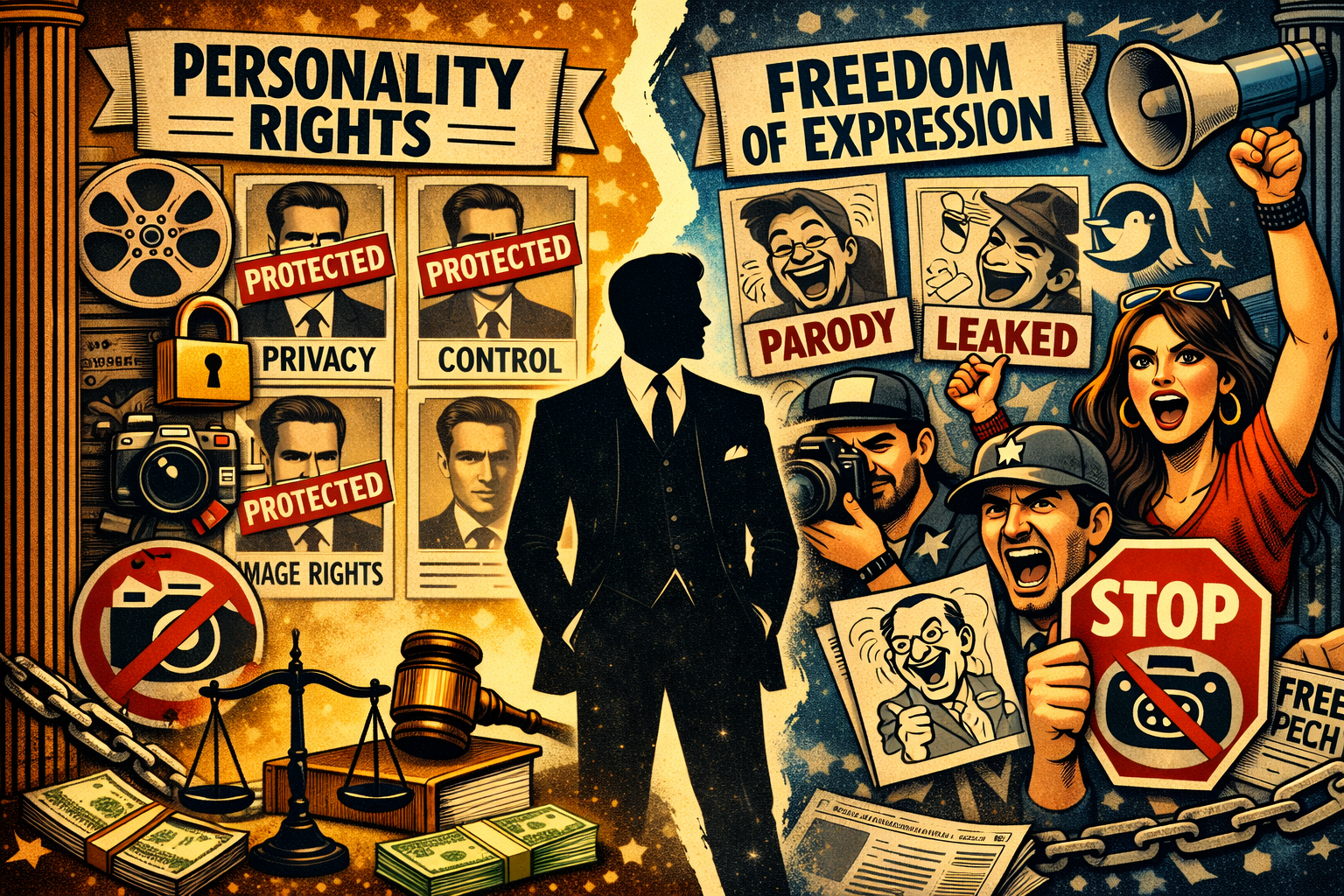
Personality rights protect those aspects of identity that render an individual recognisable, including their name, voice, image, likeness, distinctive mannerisms, gestures, and other uniquely identifiable characteristics[1]. Where these attributes carry commercial value and lend themselves to exploitation, they evolve into what is understood as the right of publicity. Despite India’s relatively recent constitutional framework, Indian courts have long acknowledged and safeguarded the right of publicity as a natural extension of personality itself.
But the law did not begin neatly. The seed of personality rights in India wasn’t planted by a single act of Parliament; it was germinated by necessity. Courts were required to respond to unauthorised merchandise, misleading endorsements, and identity imitation long before a doctrinal framework existed. The legal system relied on a patchwork of tools, be it copyright for performances, trademarks for names, or constitutional principles for privacy. For decades, unauthorized merchandise, misleading endorsements, and character imitation operated in a grey zone. The issue first came into sharp focus with R. Rajgopal[2] seeking to publish a magazine of Auto Shankar, a man convicted for as many as six murders. What followed was a plethora of cases asserting control over privacy, seeking to exercise their ‘right to be left alone’, a right to safeguard the privacy of their own, their family, marriage, procreation, motherhood, childbearing, and education, among other matters[3].
In the absence of a standalone statute governing personality rights, Indian courts have delineated their scope by drawing from existing constitutional and statutory provisions. This includes constitutional protections relating to privacy, livelihood, and publicity, alongside statutory recognition of names and signatures within the definition of a trade mark under the Trade Marks Act, 1999, performers’ rights under the Copyright Act, 1957, and the regulatory framework of the ASCI (Advertising Standards Council of India) Code in the context of advertising. Over time, personality rights have thus evolved through the cumulative application of these principles rather than through any single legislative instrument.
The entertainment industry forced clarity – the law was compelled to engage meaningfully with personality rights when celebrities such as Daler Mehndi[4] sought to restrain the sale of low-budget dolls that commercially exploited his likeness and infringed the copyright in the underlying literary and musical works of his song. This was soon followed by instances where Amitabh Bachchan and Jaya Bachchan[5] were falsely depicted on hoardings as endorsing products, in infringement of copyright in their images and in disregard of exclusive endorsement rights under the “Agreement for Services” for Tanishq Diamond Jewellery. The misuse only intensified with time. Actors such as Nagarjuna[6] approached courts to restrain pornographic websites from morphing their images and misusing their names, while filmmakers like Karan Johar[7] sought to prevent the unauthorised use of their names in film titles. Spiritual leaders, including Sri Sri Ravi Shankar[8] and Sadhguru[9], moved courts to restrain AI-driven impersonation through deepfake technologies and rogue websites, falsely suggesting personal endorsement. Singers such as Asha Bhosle[10] and Arijit Singh[11] have similarly sought injunctions against AI-generated music that imitates their voices or fabricates songs in their style. It was against this expanding landscape of unchecked commercial and digital misuse that the judiciary was forced to confront a foundational question: if a reputation takes a lifetime to build, should it really take so little to destroy it?
Misuse, however, was not industry-specific. Businessmen and political figures were not spared from another dimension of misuse, being domain name capitalisation and false association. Arun Jaitley[12], a senior advocate, prominent political leader, and at the time the Leader of Opposition in the Rajya Sabha, instituted a suit seeking a permanent injunction to restrain the misuse of his name and to secure the immediate transfer of the domain name www.arunjaitley.com. This was followed by proceedings involving Mr. Cyrus Pallonji Mistry[13], who had been appointed Deputy Chairman of Tata Sons Limited. Shortly after the public announcement of his appointment, domain names www.cyrusmistry.co.uk and www.cyrusmistry.co were registered by third parties, indicating an attempt to capitalise on the news. Both domains displayed notices stating that the domain names were ‘for sale’. The registrant subsequently threatened that, unless the domains were purchased, they could be misused in a manner detrimental to the Tata brand, and later offered to sell them for a ‘valuable consideration’, thereby confirming mala fide intent. The defendants were ultimately restrained from such misuse.
In the private sector, Akshay Tanna[14], a partner and head of private equity at KKR India Advisors Private Limited, initiated proceedings against defendants who had created fake social media pages on Facebook and Instagram, as well as groups on WhatsApp and Telegram, using his name and photograph. These platforms falsely purported to offer financial services and investment advice, creating the impression of association with or endorsement by the plaintiff and KKR. A deepfake video depicting the plaintiff giving investment advice was also circulated. The defendants were permanently restrained, and the court directed Telegram FZ LLC and Meta Platforms Inc. to remove, block, and delete the identified fraudulent accounts, profiles, and groups.
Similarly, Ankur Warikoo[15], a personal finance educator and entrepreneur, approached the court to protect his personality rights after deepfake content was used to lure individuals into WhatsApp groups promoting risky investments, resulting in financial losses. Despite complaints to Meta, the Cyber Crime Cell, and the Grievance Appellate Committee, much of the infringing content remained active. The Delhi High Court granted an ad-interim injunction restraining the defendants and directing the takedown of the impugned content.
On one side, you have individuals and entities who have invested decades in building a persona of trust, artistry, and excellence. On the other hand, you have infringers who can appropriate, manipulate, and monetize that persona with near-zero investment and near-total anonymity. The damage is no longer merely commercial dilution; it is reputational evisceration.
But protection has boundaries. Personality rights do not extend to events, mascots, or organisations simply because these entities acquire visibility or commercial appeal. This became evident in ICC Development (International) Ltd.[16], where the court clarified that the right of publicity is tied to personhood. A “person”, the court noted, is an individual human being, and the right of publicity, having evolved from the right to privacy, can attach only to an individual or to elements that uniquely identify that individual, such as a name, voice, signature, or personal attributes. While an individual may gain publicity rights through association with an event, a sport, or a film, that right does not travel back to the event itself or to the corporate body organising it. To hold otherwise would shift control over identity from individuals to non-human entities, a result the court found inconsistent with constitutional protections under Articles 19 and 21. Simply put, a persona cannot be monopolised; the right of publicity vests in the individual, and in the individual alone. That is why the unauthorised use of names such as Kapil Dev or Sachin Tendulkar in connection with the ‘World Cup’ would be actionable, not because of the event, but because of the individuals behind those names.
Nor are individual rights absolute. This balance was tested in Gautam Gambhir[17] case, where the court refused to restrain another individual bearing the same name from running restaurants under the branding “by Gautam Gambhir.” While the cricketer pointed to instances of public confusion, the court drew a clear line between misrepresentation and honest use. An individual, it held, is entitled to carry on business in their own name, so long as there is no additional conduct suggesting a false association. In the absence of any overt misrepresentation, demonstrable loss of goodwill, or sustained confusion, the defendant’s bona fide use of his own name was found not to infringe the plaintiff’s personality rights.
The Information Technology (Intermediary Guidelines and Digital Media Ethics Code) Rules, 2021 (as updated on 22.10.2025) introduce enhanced due-diligence obligations on intermediaries. Clause 3(2)(b) mandates expeditious takedown, within 24 hours of content that is prima facie exploitative, including material exposing private areas, depicting nudity or sexual conduct, or involving impersonation in electronic form, expressly covering artificially morphed images. In parallel, a subsequent notification proposes additional due-diligence requirements for synthetically generated information, obligating intermediaries that enable the creation or alteration of such content to ensure prominent labelling or permanent metadata identifiers, clearly signalling that the content is AI-generated. These identifiers must be visibly or audibly displayed in a prescribed manner to allow immediate recognition. While these regulatory interventions appear promising in principle, they have yet to be formally implemented and operationalised.
Presently, however, across cases, a clear judicial pattern emerges: the swift grant of ad-interim injunctions. Litigation in personality rights disputes has increasingly narrowed to identifying defendants and restraining their conduct. In many instances, the inquiry ends there. There is undeniable value in this approach. Interim injunctions serve as an important principle, particularly where reputational harm is immediate and irreparable. On that, there is little dispute. Yet restraint alone cannot be the endgame. What often goes unexamined is the infringing material itself, the volume of unauthorised merchandise already in circulation, the absence of recall mechanisms, and the lack of measures to prevent continued market penetration. Prayers for the appointment of court receivers or supply-chain intervention remain rare, leaving enforcement largely reactive. The result is a system that risks becoming a contest of injunctions rather than a framework of deterrence. The core purpose of personality and intellectual property rights is not merely to restrain misuse, but to prevent reputational harm from flooding the market. Without addressing circulation and scale, protection devolves into a guessing game between what is authentic and what is merely convincing.
[1] Jaikishan Kakubhai Saraf Alias Jackie Shroff Versus The Peppy Store & Ors. Cs(Comm) 389/2024
[2] R. Rajagopal And Ors. Vs. State Of Tamil Nadu And Ors. Manu/Sc/0056/1995
[3] Supra
[4] D.M. Entertainment Pvt. Ltd. Vs. Baby Gift House And Ors. Manu/De/2043/2010
[5] Titan Industries Ltd. V. Ramkumar Jewellers Cs (Os) No. 2662/2011
[6]AKKINENI NAGARJUNA Vs. WWW.BFXXX.ORG & ORS. CS(COMM) 1023/2025
[7] Sanjay v. Karan Johar and Ors. Sanjay v. Karan Johar and Ors. MANU/MH/2860/2025
[8] RAVI SHANKAR v. JOHN DOE(S) / ASHOK KUMAR(S) & ORS. CS(COMM) 889/2025 & I.A. 20793-20797/2025
[9] Jagadish Vasudev & Anr v. Igor Isakov & Ors CS(COMM) 578/2025
[10] Asha Bhosle Vs. Mayk Inc Interim Application (L) No. 30382 of 2025 in Commercial IP Suit (L) No. 30262 of 2025
[11] Arijit Singh Vs. Codible Ventures LLP and Ors.
[12] Arun Jaitley Vs. Network Solutions Private Limited and Ors. MANU/DE/2483/2011
[13] Tata Sons Limited and Ors. Vs. Aniket Singh CS (OS) 681/2012
[14] Akshay Tanna Vs. John Doe and Ors. MANU/DE/8711/2024
[15] Ankur Warikoo & Anr. v. John Doe & Ors CS(COMM) 514/2025 with I.A. 13419/2025
[16] ICC Development (International) Ltd. Vs. Arvee Enterprises and Ors. MANU/DE/0053/2003
[17] Gautam Gambhir Vs. D.A.P & Co. and Ors. MANU/DE/5440/2017